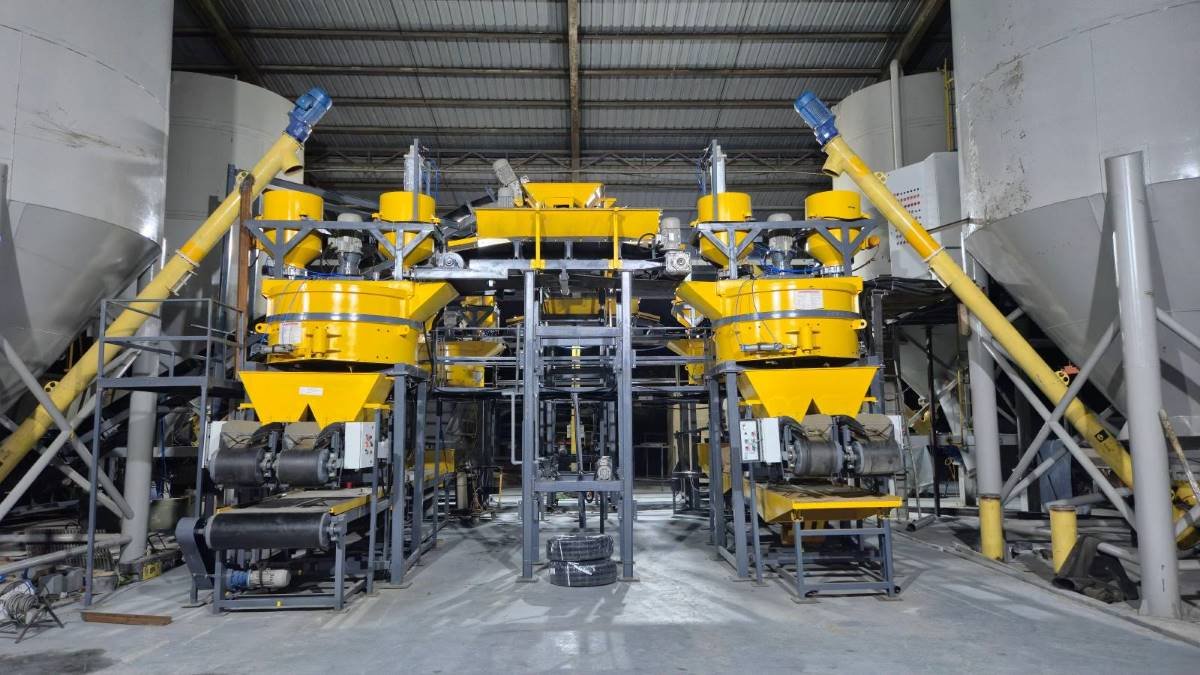
Step by Step Manufacturing Process of Semi-Automatic Rubber Mould Paver Block Plant
Once the manual feeding stage is complete, the semi-automatic plant functions identically to
the single line automatic plant, ensuring your production quality remains at an elite,
industrial standard. Here is how the complete assembly line flows:
1. Manual Raw Material Feeding: The process begins with the manual
handling of raw materials. Workers measure out the specific ratios of fine aggregates,
coarse aggregates, and cement required for your concrete grade. Using manual labor or
basic loaders, these materials are physically transported and fed directly into the
planetary mixer's loading chute.
2. Heavy Duty Planetary Mixing:Once the raw materials are manually
loaded into the Planetary Mixer, the machine takes over to ensure a perfectly homogenous
blend. Inside the mixer, rotating blades aggressively fold the heavy aggregates and
cement.Water and construction chemicals (such as plasticizers) are introduced into the
mix to achieve the precise moisture and consistency required for high grade paver
blocks.
3. Top Layer Preparation (Colour Mixing & Filling):A premium paver block
requires a dense, weather resistant, and aesthetically pleasing top layer. This vibrant
mix is manually poured into high quality rubber moulds. The workers ensure the colour
layer reaches a precise height of 8mm to 10mm inside the mould.
4. Initial Compaction (First Vibration Phase): Once filled with the
colour layer, the rubber moulds are placed onto the first set of 2 Vibrator Tables. The
heavy, high frequency vibration instantly settles the pigmented concrete, driving any
trapped air bubbles to the surface. This crucial step prevents surface voids and ensures
the final paver block has a smooth, glossy, and professional finish.
5. Structural Base Filling and Final Vibration: While the top layer sets
on the first vibrator tables, the base concrete finishes mixing in the planetary unit.
The heavy concrete base is discharged into a concrete dozer or holding station. Workers
manually fill this base concrete directly on top of the vibrated colour layer until the
mould is completely full. The fully loaded moulds are then pushed continuously onto the
remaining 2 Vibrator Tables. By passing over this second set of tables, the two layers
are fused together under intense vibration. The extreme compaction eliminates internal
air pockets, creating a dense, high-load-bearing structural block.
6. Curing and Demoulding: After exiting the vibration tables, the heavy,
filled rubber moulds are manually stacked onto wooden pallets. These pallets are moved
to a designated curing zone where the concrete is left to set and harden overnight. The
following day, the solid blocks are extracted from the rubber casings using a mechanized
Demoulding Machine. This machine ensures the blocks are safely removed without chipping
the edges or damaging the reusable rubber moulds. The finished blocks are then moved to
a water curing yard to achieve their ultimate compressive strength.