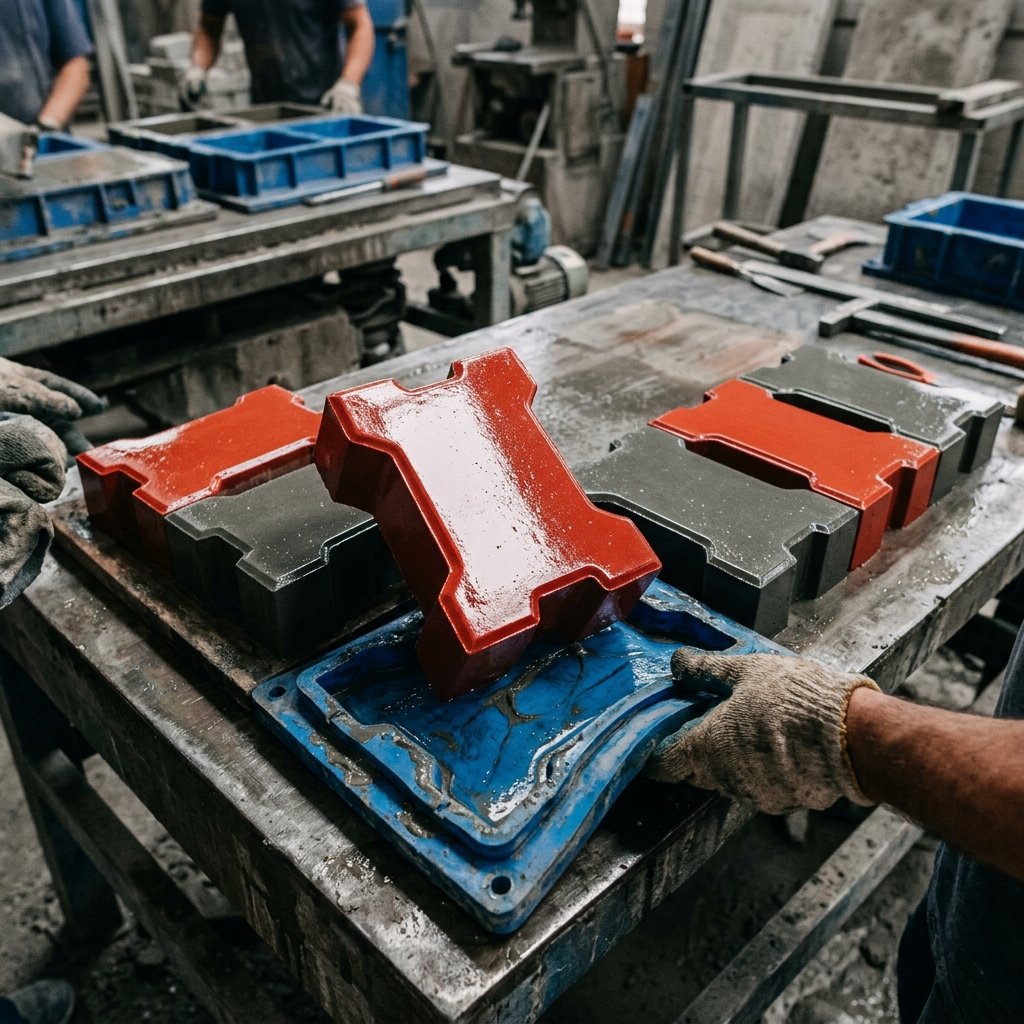
Glossy finish paver block problems troubleshooting

Mastering the Glossy Finish: Troubleshooting Common Defects in Rubber Mould Paver Production

"Are air bubbles ruining your premium pavers? Learn the industry standard techniques for using vibrating tables and correct cement ratios to achieve a flawless finish every time."

Operating a successful rubber mould paver block plant requires strict quality control in concrete paving. Even with high grade machinery, production lines can face common paver block surface defects if the operators do not follow standard mix designs or concrete compaction practices. Here is a technical guide on troubleshooting defects and achieving a mirror like finish.

1. Preventing Surface Air Bubbles (Pinholes)

Air bubbles are the most frequent surface defect. They occur when air gets trapped between the wet concrete mix and the inner face of the rubber mould. To prevent this, your vibrating table for paver blocks must have an optimal frequency and amplitude. Vibrate the first colored top layer for precisely 15 to 20 seconds. Under vibration leaves air trapped, while over vibration causes aggregate segregation, resulting in a weak top crust.

2. Solving Corner Cracking & Demoulding Breaks

If the corners of your paver blocks break off during demoulding, it points to a curing or water ratio issue. Ensure your concrete mix ratio matches the M30 grade: 1 part OPC 53 grade cement, 1.5 parts sand, and 3 parts stone chips (6mm to 10mm). Keep the water to cement ratio strictly between 0.32 and 0.38, using a PCE superplasticizer to maintain workability. Stack filled moulds on a completely level surface and cure in a shaded zone covered with thick plastic sheets to trap exothermic heat.

3. Achieving the Premium Glassy Finish

To achieve a mirror like gloss, use high quality synthetic iron oxide pigments and ensure your top layer aggregates are completely free of silt or dirt. The inner surfaces of the rubber moulds must be clean. Wash moulds with water after demoulding. True vulcanized rubber moulds have natural release properties, so avoid greasy, low grade release oils that can trap air and degrade the mould material.

Balasaheb, Founder of Balaji Construction Machines & Spares

Written & Reviewed by Balasaheb

Founder of Balaji Construction Machines & Spares. With over 19 years of hands on expertise engineering industrial wet cast brick, block, and concrete planetary mixing machinery, Balasaheb is a trusted authority in concrete production optimization.